My Oracle Blog
Signal Integrity
Voltage Standing Wave Ratio
To understand what is VSWR, we need to talk a little bit about signal propagation in radio frequency systems. To put it simply, the radio frequency signals are driven by electric cables between transmitters / receivers to their respective antennas. – By its definition, VSWR or Voltage Standing Wave Ratio is a ratio of peak voltage on the minimum amplitude of voltage of standign wave. It does not help much, does it?
Okay, let’s try to see how it relates …
In radio frequency systems, the characteristic impedance is one of the most important factors to consider.
In our case this factor is typically 50 Ohms.
50 Ohms is a constructive parameter, ie is some characteristic determined by its construction. In the case of a cable for example, depends on the size of the inner and outer conductors, and the type of insulation between them.
Typically components of a link – cables, connectors, antennas – are constructed to have the same impedance.
When we insert an element in our system, we have what we call the Inserción Loss, which can be understood as something that is lost, taking into account what that actually went in and came out. And this loss occurs in two ways – by Attenuation – especially on cable – and y Reflection.
As for the attenuation along the cables, there’s not much we can do. Part of the signal is lost along the cable by the generation of heat and also by unwanted radiated off the handle. This loss is characteristic of the same, and defined in terms of dB per lenght unit – the longer the cable is, the greater is the loss. This attenuation also increases with increasing temperature and frequency. Unfortunately, these factors are not much scope of our control, since the frequency is already preset by the system we use, and the temperature will be exposed to climatic variations of where the cable has to pass . The most we can do is try to use cable with less attenuation , ie, cableswith high quality materials used in its construction of the drivers internal and external and insulating
I’m reading…
Newnes Dictionary of Electronics on Scribd
Check it out:
I’m reading…
Signal Integrity Academy
Online video classes with Dr. Eric Bogatin.
Check it out!
I’m reading…
Electronics Calculations Data Handbook on Scribd.
Check it out:
Teledyne Education TV
Solaris

Sun Microsystems
Historically, Solaris was developed as proprietary software. In June 2005, Sun Microsystems released most of the codebase under the CDDL license, and founded the OpenSolaris open-source project. With OpenSolaris, Sun wanted to build a developer and user community around the software. After the acquisition of Sun Microsystems in January 2010, Oracle decided to discontinue the OpenSolaris distribution and the development model. In August 2010, Oracle discontinued providing public updates to the source code of the Solaris kernel, effectively turning Solaris 11 back into a closed source proprietary operating system. Following that, OpenSolaris was forked as illumos and is alive through several illumos distributions.
DePaul-1995
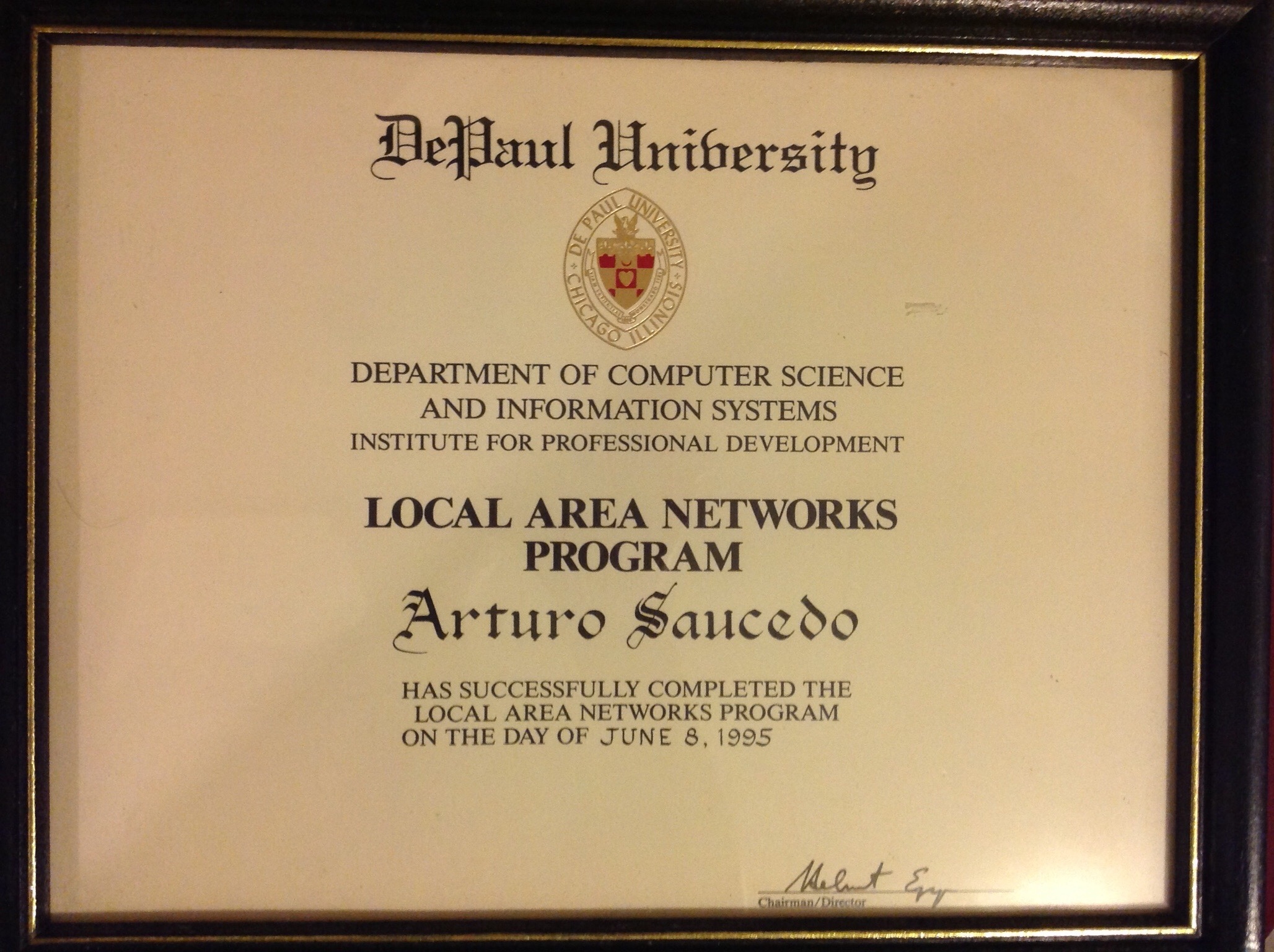
Networking
 Art.S
Art.S 